How to Choose Trench Drain Grating for US Industrial Facilities
Choosing trench drain grating means matching the material, load class, and open area to your facility's traffic and environment.

Trench drain grating is the load-bearing, water-inlet surface over a drainage channel. Choosing it correctly means matching three things: the load class of your traffic, the chemical and environmental exposure, and the hydraulic opening you need. A grate that fails any one test will crack, corrode, clog, or create a safety hazard, often within the first year. This guide focuses on industrial trench covers. AMMS Global supplies steel, aluminium, stainless steel and FRP grating for trench covers, and the selection logic below applies to those material families.
Matching Material to the Environment
Cast iron remains the default for many US industrial sites because it handles heavy pneumatic tire traffic and resists abrasion. Gray iron grates rated for medium duty, such as those engineered for sidewalk applications with occasional pneumatic tire traffic, typically carry a proof load around 12,150 pounds. Ductile iron is tougher and better where impact loading occurs, such as forklift crossings or loading docks.
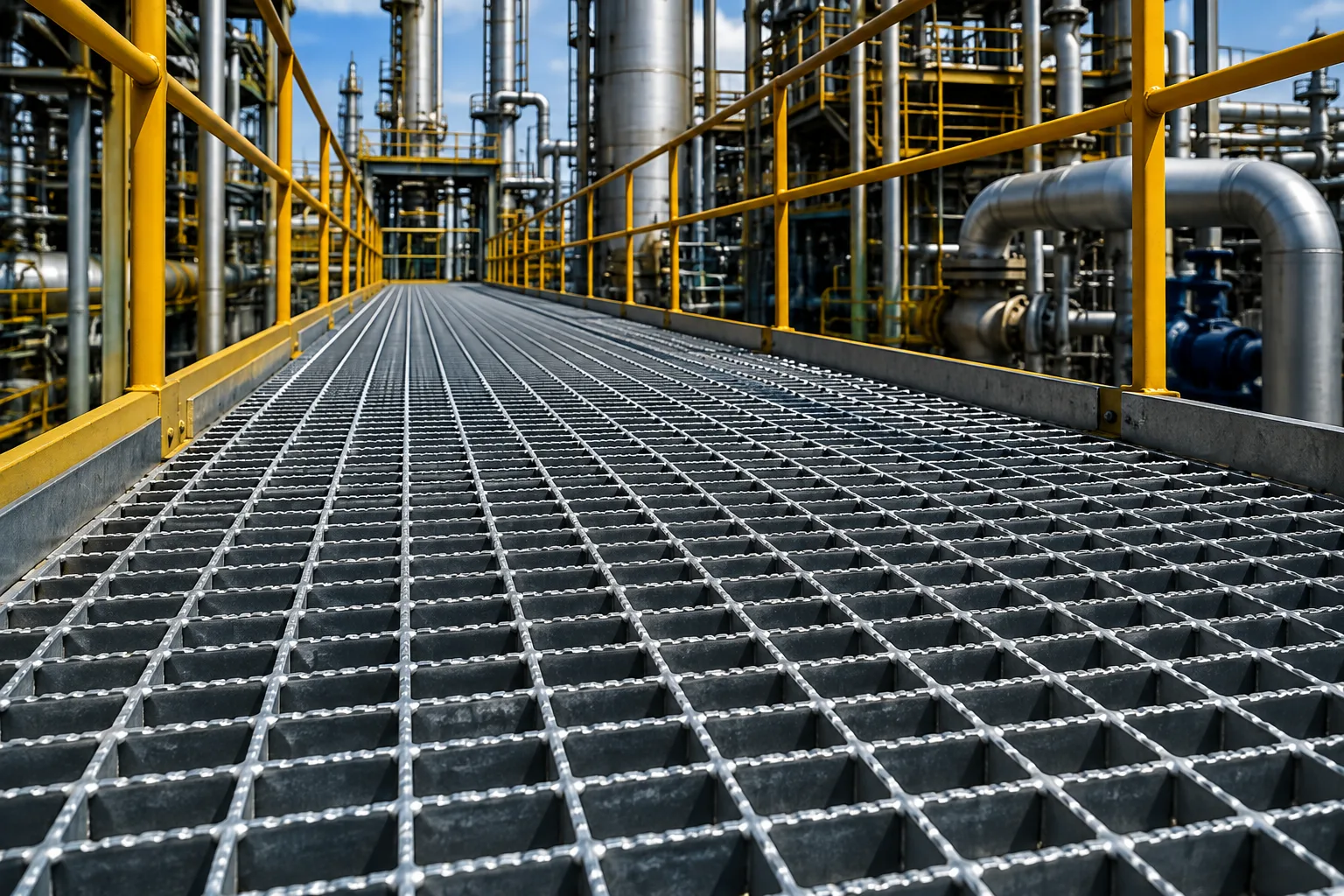
Steel grating covers a wide industrial range. Bar Grating and Welded Bar Grating provide high open area and excellent strength-to-weight ratio, which matters when spans are long or debris must pass through freely. Press-Locked Grating offers a smoother, more architectural surface while retaining strength, often specified where carts or foot traffic cross the trench. Grip Strut Grating adds a serrated, slip-resistant walking surface, valuable in wet or oily zones.
Aluminium Grating is lighter and naturally corrosion-resistant, practical for food and beverage plants, breweries, and areas where stainless steel is not mandatory but carbon steel would rust quickly. Stainless Steel Grating suits chemical processing, pharmaceutical facilities, and environments with frequent washdowns or aggressive cleaning agents. Fiberglass Grating, also called FRP grating, resists acids and salts and is non-conductive, suiting chemical plants, water treatment facilities, and electrical rooms.
Load Class and Frame Support
The grate and frame work as a system. A heavy duty grate in a light-duty frame will still fail because the frame deforms or the seat loses support. Load ratings follow standard classes, from light pedestrian to heavy forklift and highway traffic. The key specification is not just the grate material but the frame depth and anchoring method.
Common mistakes include specifying a grate by width alone without checking the actual seat width, or assuming a thicker grate automatically handles heavier loads. The frame must be embedded in concrete with proper haunching, and the grate must sit fully on the bearing surface without rocking. For industrial facilities, galvanized steel frames with cast iron or ductile iron grates are a common, economical pairing.
Open Area and Debris Management
Open area controls how much water enters the channel and how much debris passes through. A slotted grate with narrow openings, such as an ADA-compliant heel-proof design, protects pedestrians and small wheels but restricts flow and catches leaves and sediment. Bar grating with wider openings moves more water but allows larger debris into the channel, which can clog downstream catch basins.
The right balance depends on what falls onto the floor. In a food plant, a stainless steel slotted grate with moderate open area keeps solids out of the drain line. In a scrap yard or foundry, a heavy bar grate with high open area prevents ponding while accepting that some debris will enter the channel. Perforated Metal and Expanded Metal, including Standard Expanded Metal and Flattened Expanded Metal, provide mid-range open areas with smaller individual openings, suiting areas with fine debris or where small parts must be kept out of the drain.
Choosing the Right Grating Type for Your Facility
Grating Type | Best For | Open Area | Key Trade-off |
Cast Iron Slotted | Loading docks, drive lanes | Low to moderate | Heavy, brittle under sharp impact |
Ductile Iron Slotted | Forklift traffic, heavy vehicles | Low to moderate | Higher cost than gray iron |
Bar Grating | Industrial floors, high flow | High | Allows larger debris through |
Grip Strut Grating | Wet, oily walkways | Moderate | Serrations can hold fine debris |
Stainless Steel Slotted | Food, pharma, washdown | Low to moderate | Premium material cost |
Fiberglass Grating | Chemical, corrosive areas | Moderate | Lower stiffness over long spans |
Expanded Metal | Fine debris areas | Moderate | Less rigid than bar grating |
Installation and Maintenance Factors
The best grate fails if the trench is too shallow or the frame is not anchored correctly. Channel depth must accommodate expected flow volume plus a sediment allowance, and the grate must sit flush or slightly below the finished floor to avoid trip hazards and wheel impact. In industrial settings, grates should be secured against movement, especially where forklifts brake or turn.
Maintenance involves more than hosing the surface. Grates in food facilities need removal for channel cleaning, so weight matters. A stainless steel grate one person can lift beats a cast iron grate requiring two people and a pry bar. In outdoor industrial yards, check for debris packed between bars and frame corrosion at the concrete interface.
Practical Selection Tips
Specify the frame and grate as a matched system, not separate parts.
Check the actual clear opening, not just the nominal width.
For washdown areas, choose a material that survives the cleaning chemicals, not just the process fluids.
Consider removal weight if operators must lift grates for cleaning.
Confirm ADA compliance where pedestrian traffic crosses the trench.
The decision comes down to three questions: what drives over it, what spills onto it, and who has to lift it. Answer those first, then select the material and open area that fit. AMMS Global can supply the grating material for industrial trench covers, but the channel, frame, and site preparation determine whether that grating performs as intended.