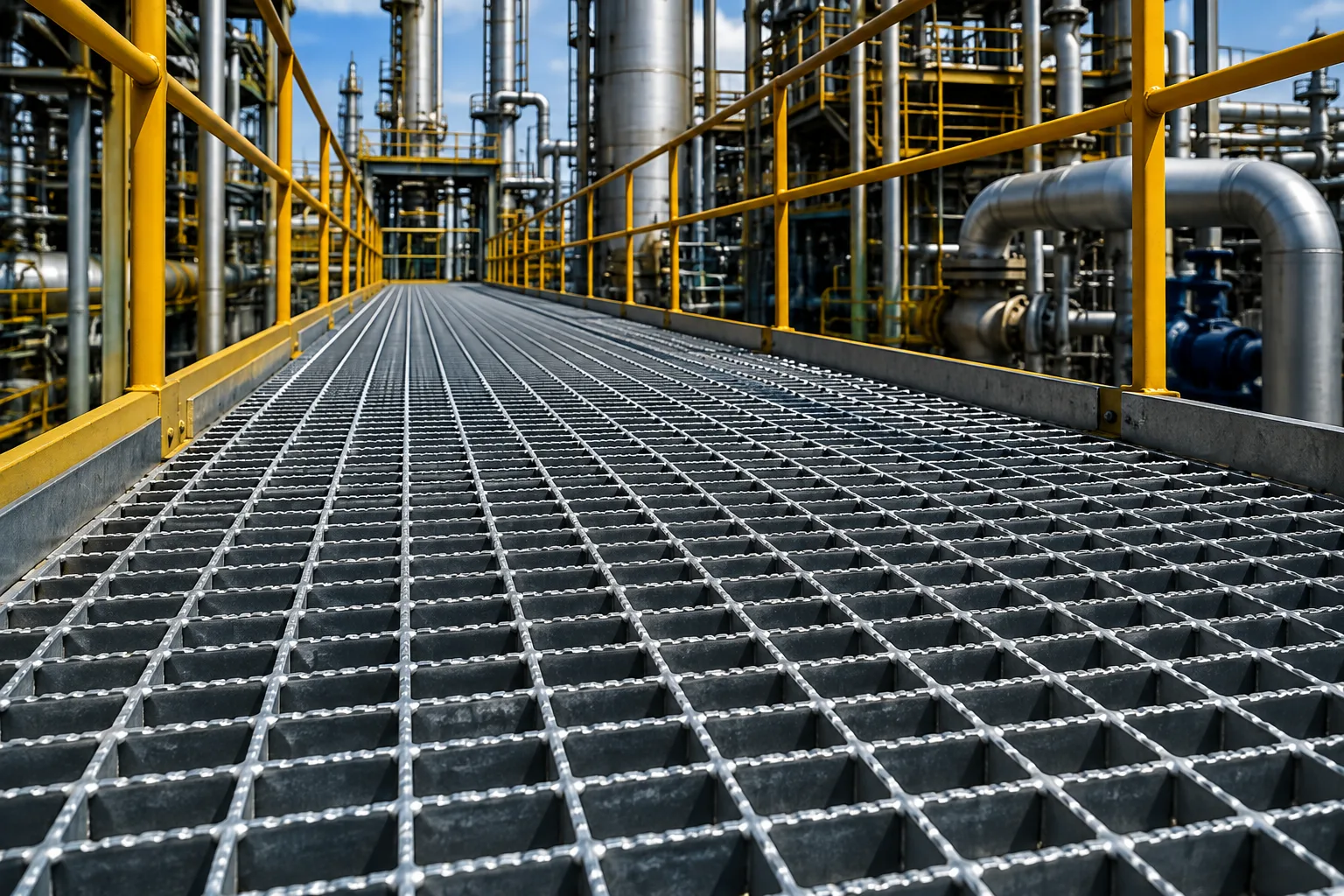
What Are Saddle Clips for Grating and How Are They Used?
Saddle clips are bolted fasteners that secure bar grating panels to steel supports without welding, and they can be removed for access.

Saddle clips are mechanical fasteners that secure bar grating panels to structural steel supports without welding. A saddle clip straddles a bearing bar, wraps around the supporting flange or angle, and is tightened with a bolt to clamp the grating in place. The method is simple, removable, and widely accepted in industrial, commercial, and municipal work. AMM Solutions supplies grating and related fastening hardware for projects where this style of attachment is specified.
Saddle Clips at the Core
Saddle clips are the traditional drilled-and-bolted approach to grating fastening. They are typically made from galvanized carbon steel, stainless steel, or aluminium, matched to the grating material and the environment. The clip has a U-shaped saddle that fits over the top or side of a bearing bar, with a threaded fastener passing through the clip and into or around the support steel below.
What separates saddle clips from newer no-drill alternatives is the attachment point. Saddle clips usually require a hole through the supporting steel or use a clamp action around the flange. Some designs bolt directly through the grating and the support, which means drilling or tapping is part of the installation. Other saddle-style clips clamp around the support flange from above, avoiding holes in the structural member while still using a bolt to tighten the assembly.
How Saddle Clips Compare to G-Clips and Other Fasteners
The most important comparison is saddle clips versus G-Clips. G-Clips are engineered no-drill fasteners that install from above with hand tools only. They do not require cutting, tapping, or drilling, and they eliminate hot-work permits and work stoppages. Saddle clips are the more conventional choice, often preferred when a bolted, through-fastened connection is required by a specification or when the support steel is already drilled.
Feature | Saddle Clips | G-Clips |
Drilling or tapping | Often required | Not required |
Installation position | From above or below | From above only |
Tools | Wrench, sometimes drill | Hand tools only |
Removability | Good, bolt-out removal | Good, clip release |
Vibration resistance | Strong when torqued correctly | Strong, vibration-tested |
Hot-work permit | Sometimes needed | Not needed |
Installation Steps and Common Mistakes
A typical saddle clip installation follows three steps: position the grating panel on the support steel, place the saddle clip over the bearing bar and support, then insert and tighten the bolt to the specified torque. The exact sequence depends on whether the clip bolts through the support or clamps around it.
One common mistake is over-tightening. A saddle clip that is torqued too hard can deform the saddle, crack a galvanized coating, or dent aluminium bearing bars. Under-tightening is just as problematic because it leaves the panel free to shift under foot traffic or vehicle loads. The right torque is the value that holds the panel firmly without visible distortion of the clip or the bar.
Another frequent error is mixing metals. Stainless saddle clips on plain steel supports can create galvanic corrosion at the contact point if moisture is present. A non-conductive separator or a compatible material pairing avoids this. For Aluminium Bar Grating, stainless fasteners are common, but the joint should be inspected more often in wet or coastal environments.
Material and Environment Matching
Saddle clips are made in galvanized steel for general industrial use, stainless steel for corrosive or washdown areas, and aluminium for weight-sensitive or non-sparking applications. The clip material should match the grating where possible. Stainless Steel Grating in a food plant should use stainless saddle clips, not zinc-plated hardware that will corrode early. Fiberglass Grating requires clips designed for its thicker, non-metallic bearing bars, and the clamping force must be distributed to avoid cracking the resin.
Welded Bar Grating and Press-Locked Grating both accept saddle clips, but the bearing bar profile differs. Press-locked grating has a tighter, flatter connection between bars, which can affect how the saddle seats. Cut-to-Size Grating Panels should be ordered with the bearing bar orientation noted so the clips land on bars, not on cross rods or open spaces.
Where Saddle Clips Fit in a Grating Project
Saddle clips are used on Platform Grating, Floor Grating, Stair Treads, and mezzanine walkways. They are also common on Grip Strut Grating when a bolted connection is preferred over the manufacturer’s standard hold-down clips. The choice between saddle clips and no-drill fasteners often comes down to whether the support steel is accessible from below, whether drilling is permitted, and whether the installation crew is already set up for bolted connections.
For projects involving Expanded Metal, Standard Expanded Metal, Flattened Expanded Metal, or Perforated Metal, saddle clips are less common because those products are usually welded or screwed along flat margins rather than clipped to bearing bars. Custom Fabrication can produce saddle clips for unusual bar spacing, deep flanges, or oversized supports when standard catalogue sizes do not fit.
Practical Buying and Specification Advice
Specify the clip material, the bearing bar height, the support flange thickness, and the bolt size before ordering. A clip that fits a 1-inch bearing bar will not necessarily seat correctly on a 1-1/4-inch bar. Check whether the support is an I-beam flange, channel, or angle, because the saddle depth must clear the flange edge.