What Are the Different Types of Industrial Grating
Industrial grating comes in welded, press-locked, swage-locked and riveted types, in steel, aluminium, stainless steel and fiberglass.
Industrial grating is an open-grid assembly of bearing bars and cross rods, typically made from steel, aluminium, or fiberglass, that creates a strong, lightweight walking or covering surface while allowing light, air, liquids, and debris to pass through. The main types are defined by how the bars are joined: welded, press-locked, swage-locked, and riveted, with further variations based on material, surface profile, and application. Choosing the right type comes down to load requirements, corrosion exposure, slip resistance needs, and whether the grating will be walked on, driven over, or used as a cover.
The Core Grating Types and Where They Fit
Most industrial grating falls into a handful of construction categories. Understanding the manufacturing method matters because it directly affects strength, appearance, and cost.
Welded Bar Grating
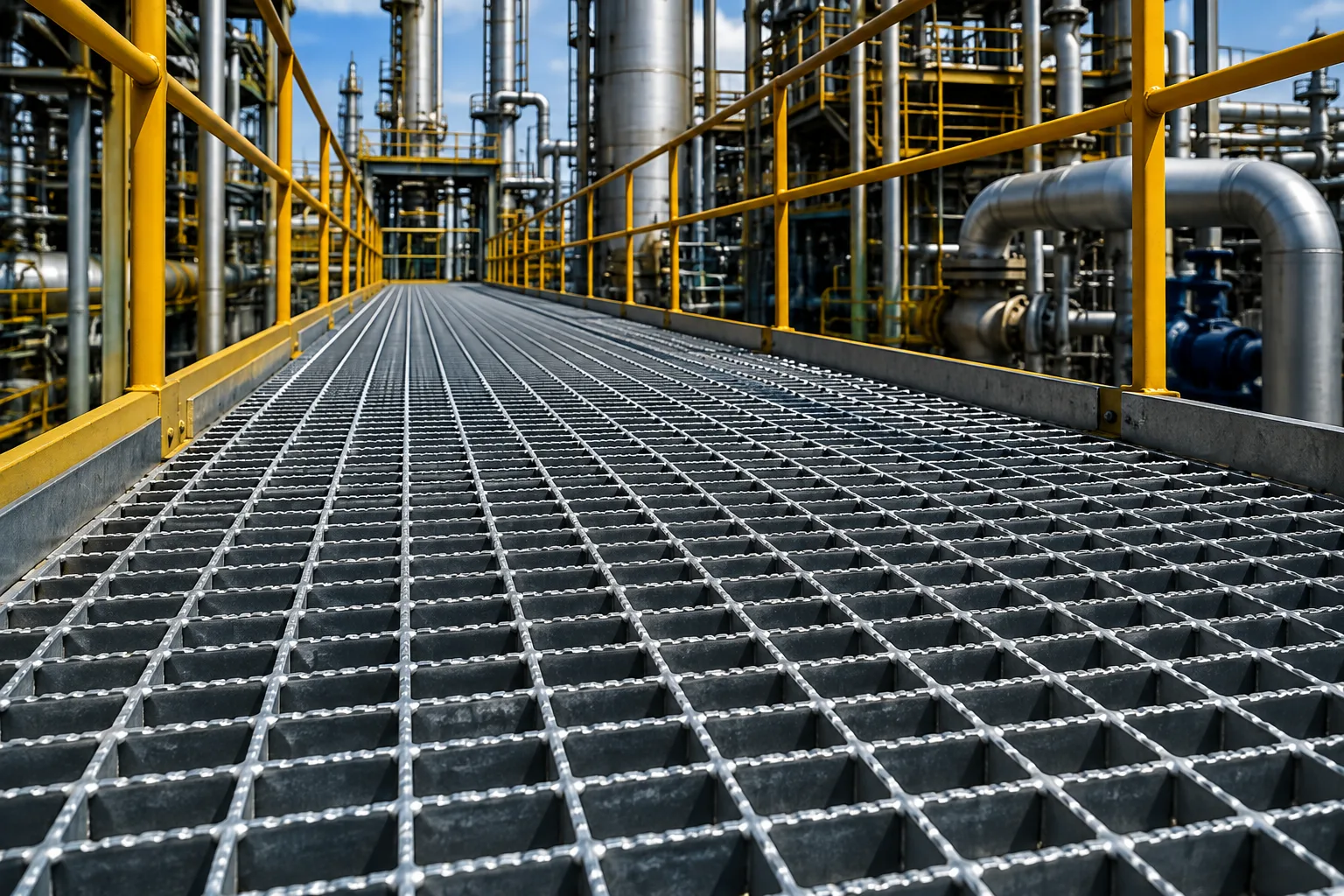
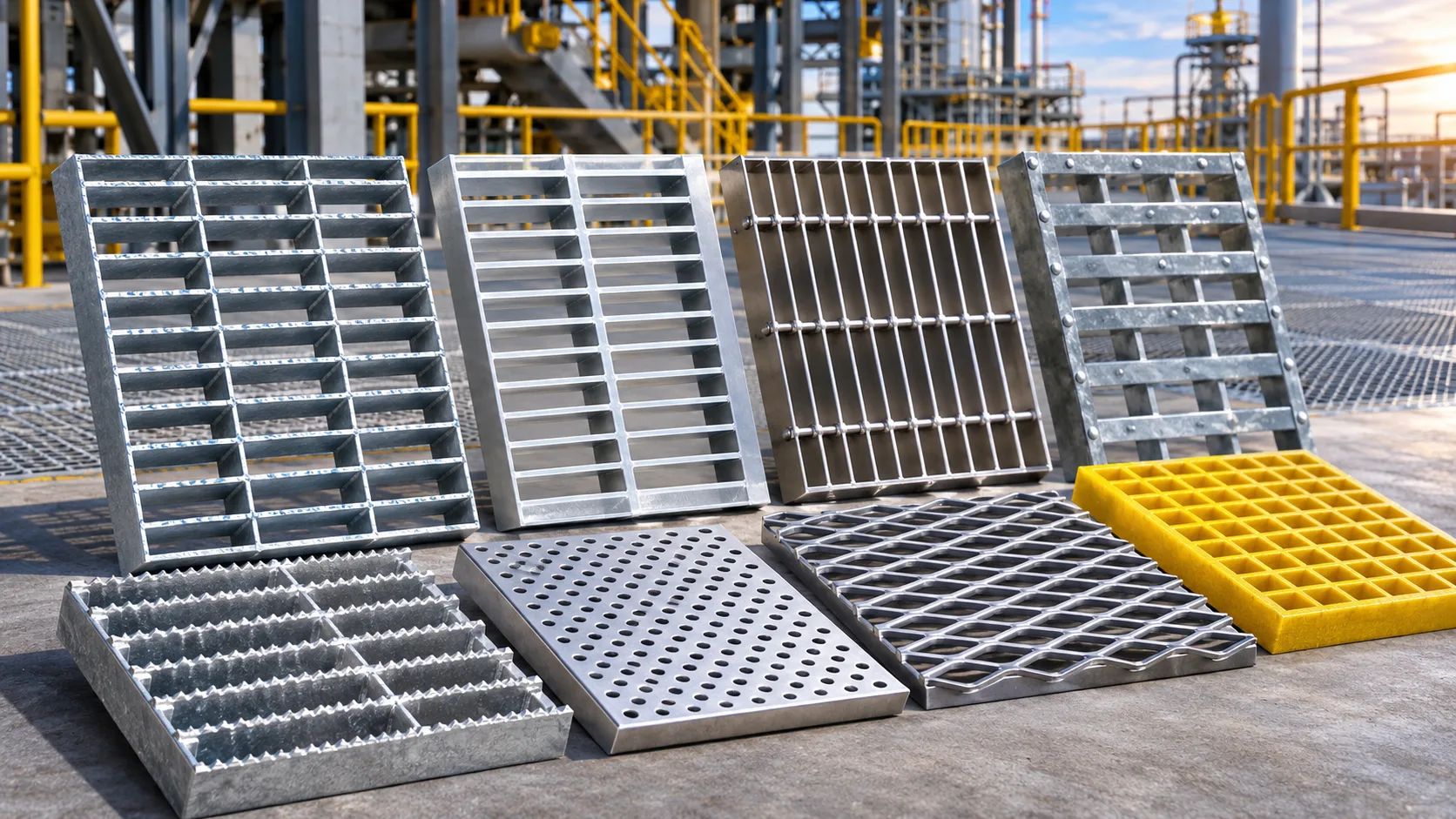
Welded bar grating is the workhorse of heavy industry. Bearing bars are fusion-welded to cross bars at every intersection, creating a rigid panel with a high strength-to-weight ratio. This type of Welded Bar Grating handles vehicular loads, heavy equipment traffic, and long spans without excessive deflection. It is commonly specified for mezzanine decks, loading docks, and trench covers in refineries and processing plants. The welded joints make it the strongest option in most load classes, though the visible weld marks give it a more utilitarian look than architectural alternatives.
Press-Locked Grating
Press-locked grating is manufactured without welding. Bearing bars and cross bars are slotted, then pressed together under high hydraulic pressure, locking them into a flush, clean panel. The result is a smooth, architectural appearance that suits public-facing applications like building facades, sunscreens, stairwells, and retail walkways. It is available in a wide range of bar spacings and often specified in stainless steel or aluminium for corrosion resistance. While strong, press-locked panels are generally better suited to pedestrian loads than heavy vehicular traffic.
Swage-Locked Grating
Swage-locked grating uses a different mechanical joining method: cross bars are inserted into pre-punched holes in the bearing bars and then deformed, or swaged, to lock them in place. This creates a flush surface similar to press-locked grating but with a slightly different load distribution. It is often chosen for architectural applications where a clean, uniform appearance matters and where moderate loads are expected.
Riveted Grating
Riveted grating is an older method still found in specific retrofit and heavy-impact applications. Cross bars are riveted to the bearing bars, producing a strong connection that tolerates vibration and impact well. It is less common in new construction but remains relevant where existing structures use riveted panels and replacements need to match.
Materials and Their Trade-Offs
The material choice is as important as the construction method. Carbon steel grating is the default for most industrial environments where corrosion is not the primary concern. It is strong, readily available, and can be hot-dip galvanized or painted for added protection. Galvanizing, where the panel is dipped in molten zinc, provides a tough, corrosion-resistant finish suitable for outdoor exposure and high-traffic areas.
Stainless steel grating is specified where corrosion resistance is critical, such as food processing, pharmaceutical plants, chemical facilities, and marine environments. It costs more than carbon steel but eliminates the need for protective coatings that can wear or chip.
Aluminium bar grating offers a lightweight alternative with natural corrosion resistance. It is easier to handle and install, making it popular for walkways, platforms, and architectural features where weight matters. The lower density means it deflects more under the same load, so spans typically need to be shorter than steel equivalents.
Fiberglass grating, also called FRP or GRP grating, is non-conductive, non-magnetic, and highly resistant to chemical attack. It is used in electrical substations, chemical plants, and wastewater facilities where metal grating would corrode or create a safety hazard. Fiberglass grating is lighter than steel but behaves differently under load and can be more susceptible to UV degradation without proper resin systems.
Surface Profiles and Specialised Forms
Beyond the basic bar-and-cross-rod construction, several specialised grating types serve specific needs. Serrated grating has notched bearing bars that provide slip resistance in wet, oily, or icy conditions. Grip strut grating is a one-piece expanded or formed metal product with a diamond-shaped perforated surface and serrated edges, offering multi-directional slip resistance. It is often used for stair treads, ladder rungs, and catwalk surfaces.
Expanded metal starts as a solid sheet that is slit and stretched into a diamond-pattern mesh. Standard expanded metal retains the raised, angled strands, while flattened expanded metal is cold-rolled to produce a smooth, flat surface. Both are lighter than bar grating and used for screening, guards, and lighter-duty walkways. Perforated metal is a solid sheet with holes punched through it, offering a different balance of openness, strength, and appearance, often chosen for architectural cladding, filtration, and acoustic panels.
Stair treads are pre-fabricated grating panels designed specifically for steps, with nosing bars and abrasive surfaces. Platform grating and floor grating refer to grating panels sized and load-rated for elevated walkways and interior flooring respectively, rather than distinct construction methods.
Choosing and Specifying Grating
The first question to answer is span direction. Grating panels are strongest when the bearing bars run perpendicular to the supporting structure. Installing a panel with the bearing bars parallel to the supports dramatically reduces its load capacity, a common and potentially dangerous mistake.
Standard panel sizes vary by manufacturer, but common widths are around 900 mm to 1000 mm with lengths up to 6000 mm or more. Cut-to-size grating panels are available for projects where standard dimensions do not fit, and custom fabrication can produce curved panels, radius cuts, and special shapes for irregular openings. AMMS Solutions supplies grating products and can advise on the right specification for a given application.
When specifying, consider the load class for drainage gratings, which ranges from A15 for pedestrian areas up to F900 for heavy-duty industrial and port applications. Also factor in bar spacing, which affects both load capacity and whether small wheels, heels, or debris can pass through.