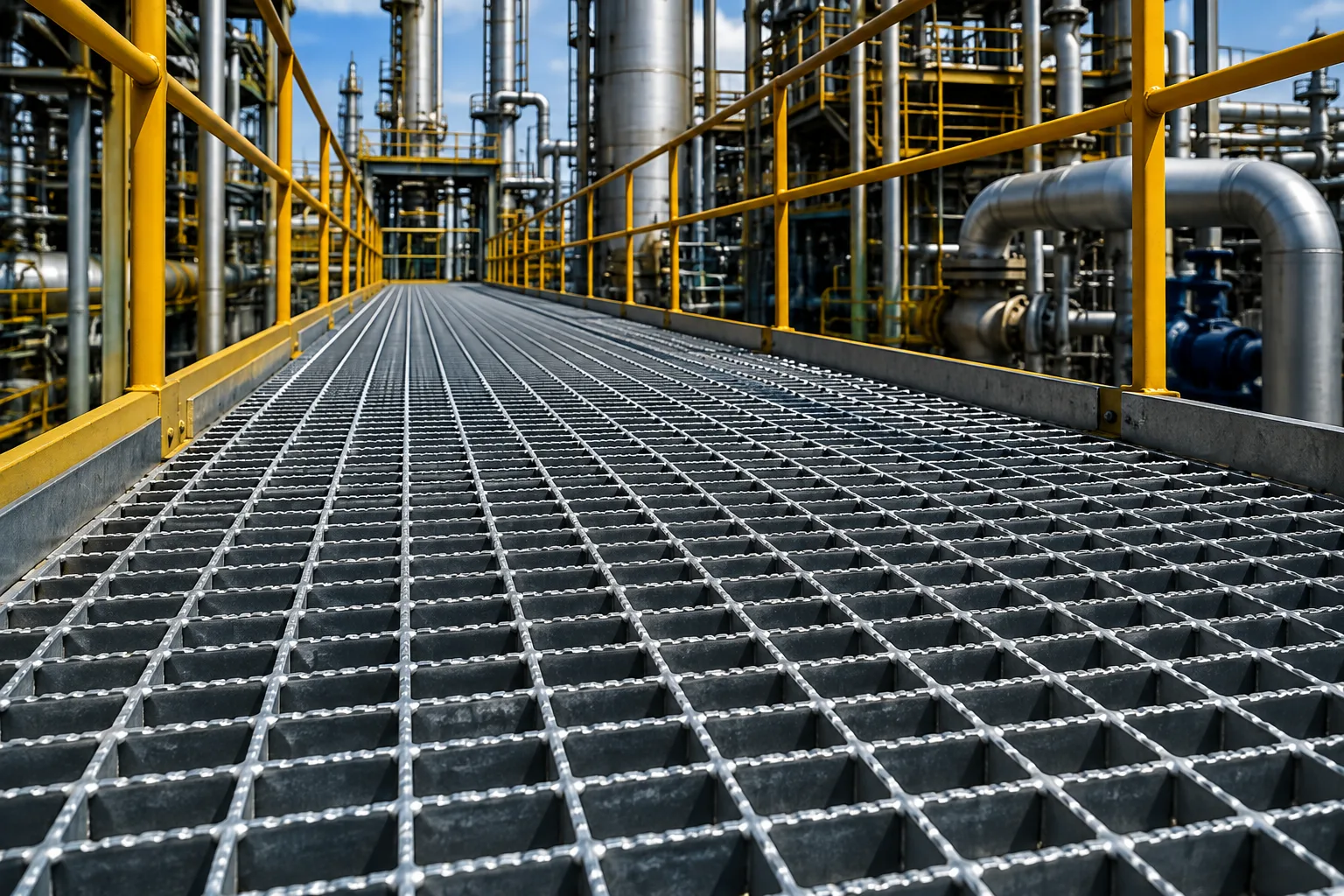
What Type of Bridge Grating Is Used in the US?
Bridge grating for US pedestrian bridges and walkways is typically welded steel, aluminum or FRP, chosen by load, environment and ADA needs.

In the US, bridge grating for pedestrian bridges, footbridges, and maintenance walkways typically uses welded carbon steel bar grating, aluminum bar grating, or fiberglass reinforced plastic (FRP) grating, depending on load requirements, environment, and ADA compliance needs. The most common specification remains welded steel with 1-3/16 inch bearing bar spacing and 4 inch cross bar spacing, often designated as 19-W-4. This article focuses on pedestrian and light maintenance applications, not highway or vehicular bridge decks.
AMMS Global works with facility owners and contractors to select bridge deck grating that balances load capacity, slip resistance, corrosion resistance, and long-term maintenance. The right choice depends less on brand and more on how the grating interacts with its support structure, environment, and expected foot traffic.
Common Bridge Grating Types in the US
Pedestrian bridge grating falls into a few distinct construction types, each with different manufacturing methods and performance characteristics.
Grating Type | Typical Materials | Best For | Key Trade-Off |
Welded bar grating | Carbon steel, stainless steel | High loads, long spans, industrial walkways | Heavier, needs corrosion protection |
Swage-locked grating | Aluminum, stainless steel | Architectural footbridges, ADA paths | Smooth look, lower load capacity |
FRP molded grating | Fiberglass reinforced plastic | Coastal or chemical environments | Corrosion-proof, higher deflection |
Press-locked grating | Aluminum, steel | Lighter pedestrian decks | Less common for bridge spans |
Welded bar grating is manufactured by forge welding rectangular bearing bars and drawn cross bars, creating a positive fused connection. This method produces the most economical design for industrial applications and offers the highest strength-to-weight ratio among metal options. Type 19-W-4 welded steel grating, with bearing bars spaced 1-3/16 inches on center and cross bars at 4 inches, remains the most widely specified product for pedestrian bridge decks in the US.
Material Options for Metal Bridge Grating
Metal bridge grating in the US is available in three primary materials, each suited to different conditions.
Carbon steel is the workhorse. It provides high load capacity at the lowest material cost, but requires hot-dip galvanizing per ASTM A123 to resist corrosion from road salt, moisture, and deicing chemicals. Galvanized steel is the standard finish for most outdoor pedestrian bridge applications.
Aluminum bar grating offers a lighter alternative, roughly one-third the weight of steel, which reduces dead load on supporting structures. Aluminum is naturally corrosion-resistant and works well in marine or humid environments. However, aluminum has lower stiffness than steel, so spans must be shorter or bearing bars deeper to achieve equivalent deflection limits.
Stainless steel, typically Type 304L or 316L, delivers excellent corrosion resistance and high strength. It is specified where deicing salts, coastal spray, or chemical exposure would compromise galvanized steel. The higher material cost limits stainless to critical applications or where lifecycle maintenance costs justify the investment.
Steel Bridge Deck Grating: What to Specify
Steel bridge deck grating for pedestrian use requires attention to bearing bar depth, thickness, and spacing. Bearing bar depth, measured in inches, has the greatest influence on span capacity. Common depths range from 1 inch to 2-1/2 inches for standard-duty welded grating, while heavy-duty welded grating uses bearing bars from 1 inch to 2-1/2 inches with increased thickness, typically 1/4 inch.
Bearing bar spacing affects both load distribution and pedestrian comfort. The 19-space pattern (1-3/16 inches) provides nearly 80 percent open area, allowing dirt, debris, snow, and liquids to pass through easily. For ADA-compliant pedestrian paths, close mesh spacing of 11-W-4 (11/16 inch) or 7-W-4 (7/16 inch) prevents cane tips, wheelchair casters, and bicycle tires from catching. When specifying 11-W-4 for ADA applications, bearing bars must be 3/16 inch thick.
Cross bar spacing is typically 4 inches on center, though 2 inch spacing is available where additional rigidity is needed. Serrated bearing bar surfaces improve slip resistance in wet or icy conditions, a common requirement for outdoor footbridges.
Load Capacity and Heavy Duty Bridge Grating
Heavy-duty bridge grating refers to welded steel grating with thicker bearing bars, typically 1/4 inch or greater, designed for higher concentrated loads or longer spans. For pedestrian bridges, the governing load is usually a uniform live load combined with point loads from maintenance equipment or small vehicles.
The critical factor is not just the grating panel itself but the support structure beneath it. Grating panels are relatively stiff in the direction of the bearing bars but flexible across the cross bars. Support members must run perpendicular to the bearing bars, and panels must be positively attached to prevent movement. Missing or corroded support angles and channels cause panels to deflect and bounce, which pedestrians perceive as unsafe even when the grating itself has not failed.
A common mistake is specifying grating based on uniform load tables without checking deflection limits. Pedestrian bridges typically require stricter deflection control than industrial floors because visible movement creates discomfort. Experienced specifiers often select the next deeper bearing bar size when deflection, not strength, controls the design.
FRP and Molded Grating Alternatives
Fiberglass grating and FRP molded grating offer a non-conductive, corrosion-resistant alternative for pedestrian bridges in coastal areas, wastewater facilities, or chemical plants. FRP molded grating is manufactured by combining fiberglass rovings with thermosetting resin in a mold, producing a one-piece panel with bidirectional strength.
FRP weighs significantly less than steel and never requires painting or galvanizing. However, FRP has lower modulus of elasticity, meaning it deflects more under the same load. Spans must be shorter, or panels thicker, to match the stiffness of steel grating. FRP also costs more initially, though lifecycle costs may favor it in highly corrosive environments where steel would require frequent recoating.
Related Grating Products and Accessories
Several related products appear in bridge and walkway specifications. Bar grating refers to the general category of open grid flooring made from bearing bars and cross rods. Platform grating and floor grating are application terms for grating used on elevated walkways, mezzanines, and maintenance platforms. Expanded metal and perforated metal are sheet-based alternatives that provide drainage and slip resistance but with less open area and lower spanning capability. Grip Strut Grating is a specific safety grating product with serrated diamond-shaped openings, often used for stair treads and ramps where multidirectional slip resistance is required.
Banding, the process of welding a flat bar around the panel perimeter, protects exposed edges and provides a finished appearance. Saddle clips, G-clips, and weld lugs secure panels to support steel. For pedestrian bridges, countersunk fasteners prevent tripping hazards.
Practical Selection Advice
Start with the support structure. Verify that existing or planned supports run perpendicular to the bearing bars and are spaced within the grating span tables. Check the actual condition of support steel, especially at column bases where rust damage commonly extends up to 18 inches.
Match the grating to the environment. Galvanized steel works for most inland locations. Aluminum or stainless steel suits coastal or deicing-salt exposure. FRP molded grating handles chemical or highly corrosive settings.
Confirm ADA requirements early. If the bridge serves the public, close mesh spacing of 11-W-4 or 7-W-4 may be mandatory. Serrated surfaces improve traction but can make snow removal harder.
Finally, specify positive attachment. Grating that is simply set into place will shift, rattle, and eventually fail. Welding, saddle clips, or mechanical fasteners at every support point prevent movement and extend service life.