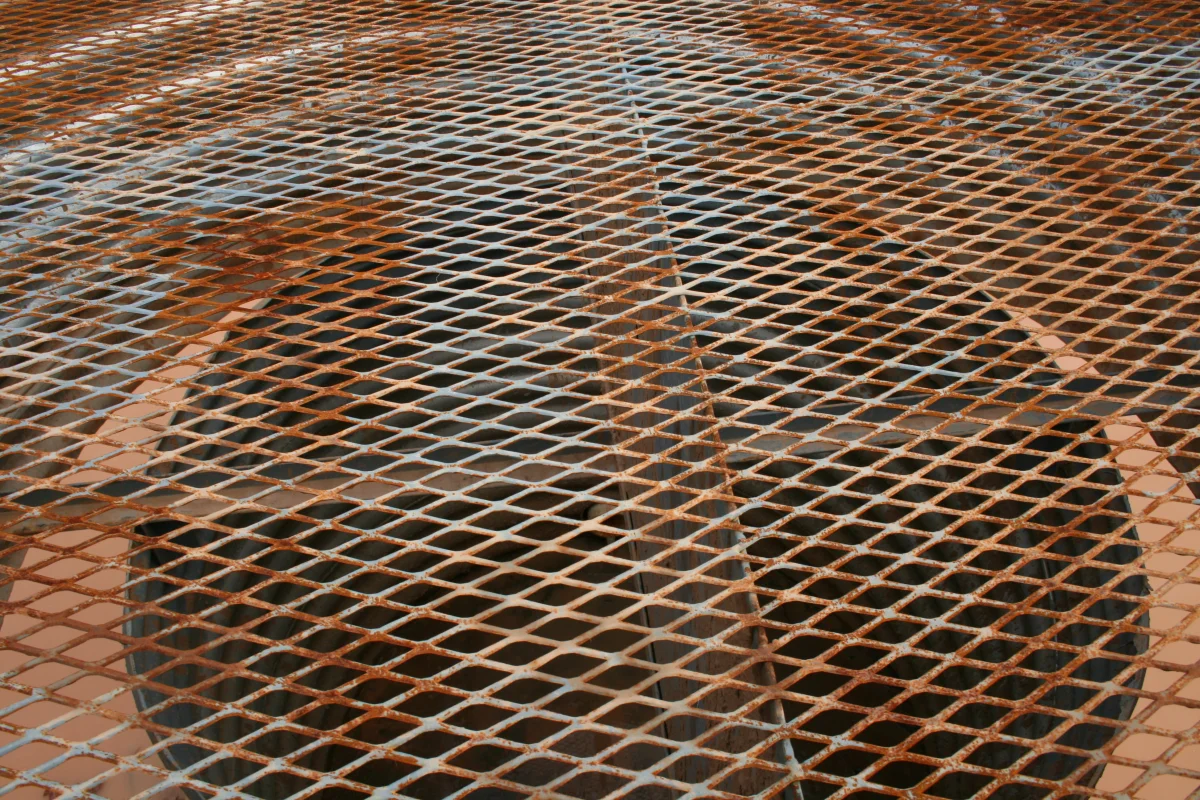
Standard expanded metal, also called raised expanded metal, is a sheet product created by slitting and stretching solid metal to form diamond-shaped openings. The 13/4 × 1 designation refers to a specific mesh pattern with a nominal opening of 1-3/4 inches in the long way of the diamond and 1 inch in the short way, making it one of the larger, more open patterns available for industrial and architectural work. AMMS Global supplies this pattern across multiple material grades where the mesh count, strand width, and sheet dimensions match project requirements.
What the 13/4 × 1 Pattern Actually Means
The naming convention for expanded metal follows a simple logic: the first number is the long way of the diamond opening, the second is the short way, both measured in inches from the center of one strand to the center of the next. In a 13/4 × 1 pattern, the long dimension runs approximately 1.75 inches and the short dimension approximately 1 inch.
The strand width and thickness vary depending on the gauge selected. Common gauges for this pattern include #13, #9, and #6, with #9 being a frequent choice for walkways and machine guards. The gauge number follows the same convention used across expanded metal: a higher number means a thinner strand. A #9 strand is thicker than a #13 strand, which directly affects load capacity, weight per square foot, and stiffness.
Material Options and Their Trade-offs
The 13/4 × 1 pattern is produced in several materials, each suited to different environments and loading conditions.
Carbon steel standard expanded metal is the workhorse option. It offers good tensile strength, welds easily, and accepts paint or powder coating well. The trade-off is corrosion resistance: unprotected carbon steel will rust in outdoor or wet environments unless finished.
Galvanized standard expanded metal starts as carbon steel and receives a hot-dip zinc coating after expansion. This makes it a practical middle ground for exterior applications where stainless steel is not justified. The coating adds some thickness to the strands, which can slightly reduce the effective opening size.
Aluminum standard expanded metal is significantly lighter than steel and naturally corrosion-resistant. It is common in architectural screening, ceiling panels, and decorative applications where weight matters more than maximum load capacity. The 13/4 × 1 pattern in aluminum is often specified for facade panels and sunscreens.
Stainless steel standard expanded metal, typically Type 304, provides the best corrosion resistance and is specified for food processing areas, chemical environments, and coastal installations. It is the most expensive option and harder to cut and form than carbon steel, but the lifecycle cost can be lower where maintenance access is limited.
Raised vs. Flattened: Why This Pattern Is Usually Raised
Standard expanded metal is raised, meaning the strands sit at an angle to the original sheet plane. The surface has a textured, three-dimensional quality that provides traction underfoot and stiffness in one direction. Flattened expanded metal is passed through a leveling roll after expansion, producing a smooth, flat surface with a slightly larger opening and reduced rigidity.
For the 13/4 × 1 pattern, raised is the default because the larger openings benefit from the added stiffness that raised strands provide. Flattened versions of this pattern do exist but are less common in inventory and typically require a mill order.
Applications Where 13/4 × 1 Fits
The relatively large opening makes this pattern well suited to applications where visibility, airflow, and light transmission matter as much as physical barrier performance.
Walkway and platform applications use the raised surface for slip resistance. When paired with structural supports, the pattern can serve as Floor Grating in light-duty pedestrian areas, though it is not a substitute for heavier Bar Grating or Grip Strut Grating where concentrated loads or long spans are involved.
Machine guards and equipment enclosures benefit from the open area, which allows heat to dissipate while preventing accidental contact with moving parts. The 13/4 × 1 pattern provides roughly 70 to 80 percent open area depending on gauge, so airflow is excellent.
Architectural screening and facade elements use the pattern in aluminum or stainless steel for visual texture, solar shading, and security. The large diamonds read clearly at a distance and create a bolder pattern than smaller mesh sizes.
Fencing and security panels use carbon steel or galvanized versions where the larger openings still prevent passage but maintain sightlines. The raised strands make climbing more difficult than a flat sheet.
Selection Factors Beyond the Pattern Name
Specifying the pattern is only the first step. Several other decisions affect how the material performs.
Sheet size matters for installation efficiency. Common stock sizes for expanded metal include 48 x 96 inch and 48 x 120 inch sheets, with some suppliers offering 60 x 120 inch or 72 x 120 inch options. The diamond orientation relative to sheet length also matters: on full 4 x 8 and 5 x 10 sheets, diamonds typically run longways, while smaller pre-cut sizes often have diamonds running shortway.
Strand thickness and width determine weight and load capacity. A #6 gauge 13/4 × 1 sheet weighs considerably more per square foot than a #13 gauge version of the same pattern. The heavier gauge may be necessary for unsupported spans, while the lighter gauge works for infill panels and screening.
Edge condition is a practical consideration. Expanded metal sheets have random edges: some diamonds are complete, others are partial. For architectural work where edges are visible, plan for a border frame or trim piece to conceal the irregular edge.
How This Pattern Compares to Other Expanded Options
The 13/4 × 1 pattern sits at the larger end of the standard expanded metal range. Smaller patterns like 1/2″ #16 or 3/4″ #9 provide a finer mesh with less open area and are better for small-part containment or finer screening. Larger patterns like 2″ #9 offer even more openness but less stiffness per square foot.
Compared to Perforated Metal, expanded metal has no scrap loss from punching holes, which makes it more economical for large open areas. The raised surface also provides more traction than a perforated sheet. Compared to Platform Grating products such as Bar Grating or Fiberglass Grating, expanded metal is lighter and less expensive but has lower load capacity for equivalent spans.
Practical Notes for Fabrication and Installation
Cutting expanded metal is straightforward with a plasma cutter, angle grinder, or shears, but the raised surface makes clean straight cuts slightly more challenging than flat sheet. Clamp the sheet securely and account for the strand angle when measuring.
Welding expanded metal to a frame works best with stitch welds at strand intersections. Over-welding thin strands can burn through, especially on #13 gauge material. For galvanized material, welding produces zinc fumes, so proper ventilation is required.
When ordering, confirm the gauge convention with the supplier. The gauge number refers to the original sheet thickness before expansion, not the final strand thickness. This is a common source of confusion when comparing quotes.
Frequently Asked Questions
How much is a 4×8 sheet of expanded metal worth?
Pricing depends on material, gauge, pattern, and current market conditions. Aluminum and stainless steel cost more than carbon steel, and heavier gauges cost more than lighter ones. Request a quote from a supplier with the full specification: pattern, gauge, material, and sheet size.
What gauge is #9 expanded metal?
The #9 gauge designation refers to the original sheet thickness before expansion, which is approximately 0.1495 inch for carbon steel. The actual strand thickness after expansion varies slightly depending on the pattern and manufacturer.
What does #9 expanded metal mean?
The #9 refers to the gauge of the original sheet metal used to produce the expanded product. It does not describe the opening size or strand width. A #9 gauge sheet produces a thicker, stiffer strand than a #13 gauge sheet, regardless of the diamond pattern.
How thick is #13 expanded metal?
The #13 gauge designation corresponds to an original sheet thickness of approximately 0.0897 inch for carbon steel. The final expanded product has a strand thickness close to this value, though the raised profile gives the sheet an overall apparent thickness greater than the strand gauge alone.


