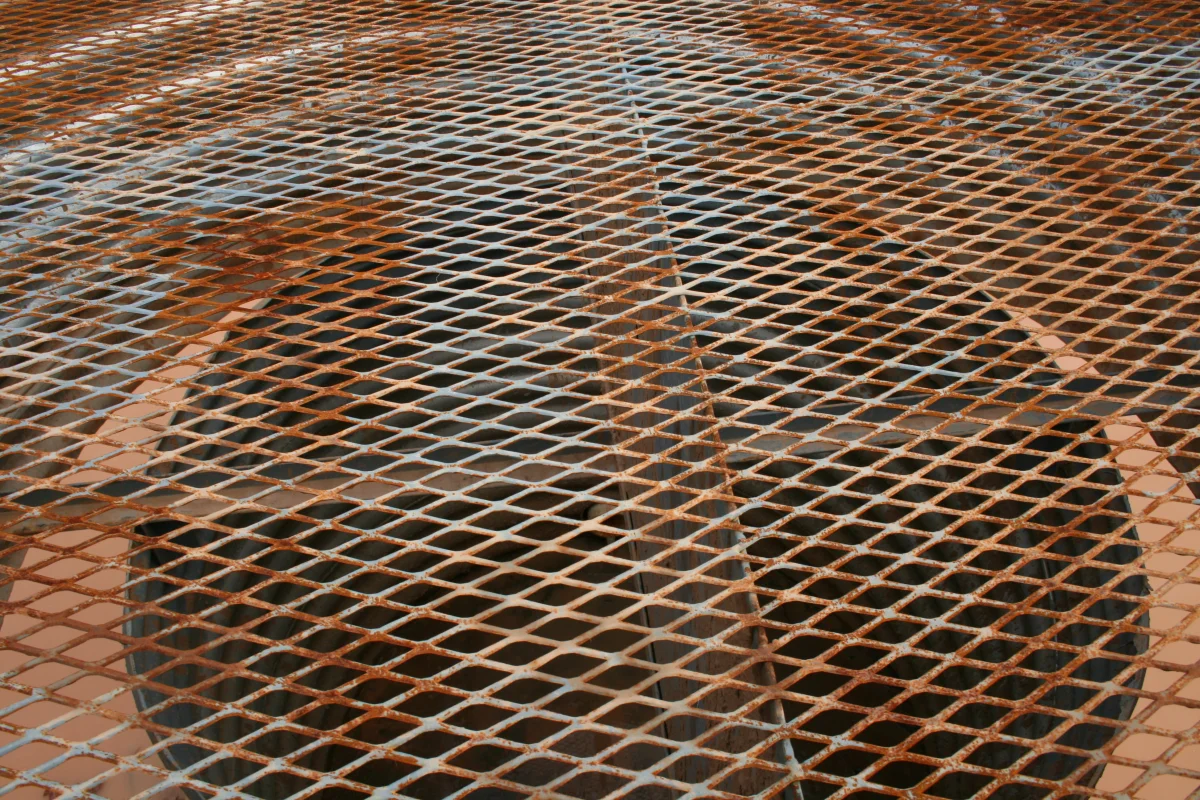
Flattened expanded metal is standard expanded metal cold-rolled after expansion to produce a smooth, level surface with diamond-shaped openings in a single plane. FEM-11 is a pattern designation commonly specified for architectural infill panels, machine guards, walkway covers, and filtration support screens where a low-profile, snag-free surface matters more than the raised texture of standard expanded metal.
AMM Solutions supplies flattened expanded metal in a range of materials and sheet sizes for industrial, architectural, and fabrication requirements. The flattened profile changes how the material handles, finishes, and performs under load, so understanding the manufacturing step and its practical consequences helps avoid specifying the wrong product.
What the Flattening Step Actually Changes
Expanded metal starts as a solid sheet slit and stretched simultaneously, creating a three-dimensional mesh with strands and bonds angled out of the original sheet plane. That raised form is called Standard Expanded Metal. When the sheet passes through a cold-rolling mill afterward, the strands and bonds are pressed flat, producing a thinner overall gauge, a slightly larger open area, and a smoother face.
Flattening lengthens the sheet slightly in the direction of rolling and reduces the non-slip texture that raised expanded metal provides. For walkway applications where slip resistance is critical, raised expanded metal or Grip Strut Grating often performs better. For enclosures, decorative screens, and guards, the flattened surface is usually preferred because it is easier to handle, weld, and finish.
FEM-11 Specification Profile
FEM-11 is not a universal industry standard but a pattern designation used by some suppliers to identify a specific strand width, bond length, and open area combination. The practical specification points to confirm before ordering are:
Strand width and thickness
Long way of diamond (LWD) and short way of diamond (SWD)
Open area percentage
Sheet size, typically 4 ft x 8 ft or 4 ft x 10 ft, with larger sizes available from some mills
Material grade and finish
The table below compares flattened expanded metal against common alternatives for typical selection factors.
Property | Flattened Expanded Metal | Standard Expanded Metal | Perforated Metal |
Surface profile | Smooth, single plane | Raised, textured | Smooth with punched holes |
Slip resistance | Moderate | Higher | Low to moderate |
Open area | 40 to 70 percent typical | Slightly lower than flattened | Varies by hole pattern |
Strength-to-weight ratio | High | Higher for same base gauge | Moderate |
Waste from manufacturing | None | None | Punching scrap produced |
Common uses | Guards, infill, screens | Walkways, ramps, stair treads | Decorative panels, acoustic screens |
Material Options and Where Each Fits
Carbon steel flattened expanded metal is the most common and economical choice for general fabrication, machine guards, and painted or powder-coated components. It is typically supplied mill finish and requires coating for outdoor use.
Galvanized flattened expanded metal offers corrosion resistance without the cost of stainless. The galvanizing is applied after expansion and flattening in most cases, so cut edges remain exposed and may need touch-up treatment in wet environments.
Aluminum flattened expanded metal is lighter and naturally corrosion-resistant, making it suitable for architectural sunshades, ceiling panels, and decorative infill where weight and appearance matter. It is softer than steel, so load-bearing applications need a heavier gauge than an equivalent steel panel.
Stainless steel flattened expanded metal provides the best corrosion resistance and is specified for food processing, chemical environments, and exterior architectural work where long-term appearance matters. It costs more and is harder to shear and form than carbon steel.
Before committing to a material, confirm current availability with AMMS Global, since mill schedules for less common alloys and sheet sizes fluctuate.
Selection Factors Beyond the Pattern
The flattened profile changes how the material behaves in fabrication. Shearing along the diamond pattern can leave partial strands at the cut edge, so edge appearance depends on where the cut falls relative to the mesh. For architectural work, a framed edge or a cut line aligned with the diamond pattern produces a cleaner result.
Open area percentage affects airflow, light transmission, and visibility. A finer diamond with thin strands gives more screening and a tighter visual texture. A larger diamond with wider strands carries more load but weighs more.
For flooring and platform applications, flattened expanded metal is not a direct substitute for Bar Grating, Fiberglass Grating, Platform Grating, or Floor Grating. Those products are engineered for pedestrian and vehicle loads with defined deflection limits. Flattened expanded metal works as an infill or cover material but should not be treated as primary structural grating unless an engineer confirms the load path.
Common Specification Mistakes
One frequent error is ordering flattened expanded metal when the application actually needs raised expanded metal for slip resistance. Another is specifying a sheet size without accounting for the fact that flattening changes final dimensions slightly compared to the pre-flattened blank. A third mistake is ignoring cut-edge finish on visible architectural panels, where a ragged sheared edge undermines the design.
Finishing also deserves attention. Powder coating adheres well to the flat surface, but the many small openings make liquid coating prone to drips and uneven coverage if applied too heavily. Anodizing works well for aluminum flattened expanded metal when the alloy is suitable.
For sourcing, working with a flattened expanded metal supplier that offers in-house shearing, custom sizing, and material traceability reduces the risk of receiving sheets that cannot be used as delivered. Ask for a cut pattern drawing when edge alignment matters.
FAQ
How to flatten a piece of metal?
Flattening expanded metal specifically requires a rolling mill that applies pressure across the full sheet width. For small pieces of solid metal, a hydraulic press, planishing hammer, or repeated passes through a slip roller can flatten the surface, but expanded metal needs the cold-rolling process to press all strands and bonds into one plane without collapsing the openings.
Can you cook on stainless steel expanded metal?
Stainless steel expanded metal is used in commercial cooking equipment as grill grates, smoker racks, and heat diffusers when the alloy is food-grade and the surface is properly cleaned. Flattened stainless expanded metal works well for this because the smooth surface is easier to clean than raised expanded metal, but it must be free of mill oils and passivated before food contact.
What will expand metal?
Heat causes metal to expand dimensionally, which is a separate concept from the slitting and stretching process that creates expanded metal mesh. In manufacturing, a sheet is expanded mechanically by cutting and stretching it simultaneously, not by heating.
Can metals be flattened into sheets?
Yes, most ductile metals can be rolled or pressed into sheet form. That is how sheet metal is produced in the first place. Flattened expanded metal takes an already expanded mesh and cold-rolls it to remove the raised profile, which is a secondary flattening step rather than primary sheet production.